


- Posted By: Derrick Stuckly
- May 15, 2026 @ 11:50 am
- Local News
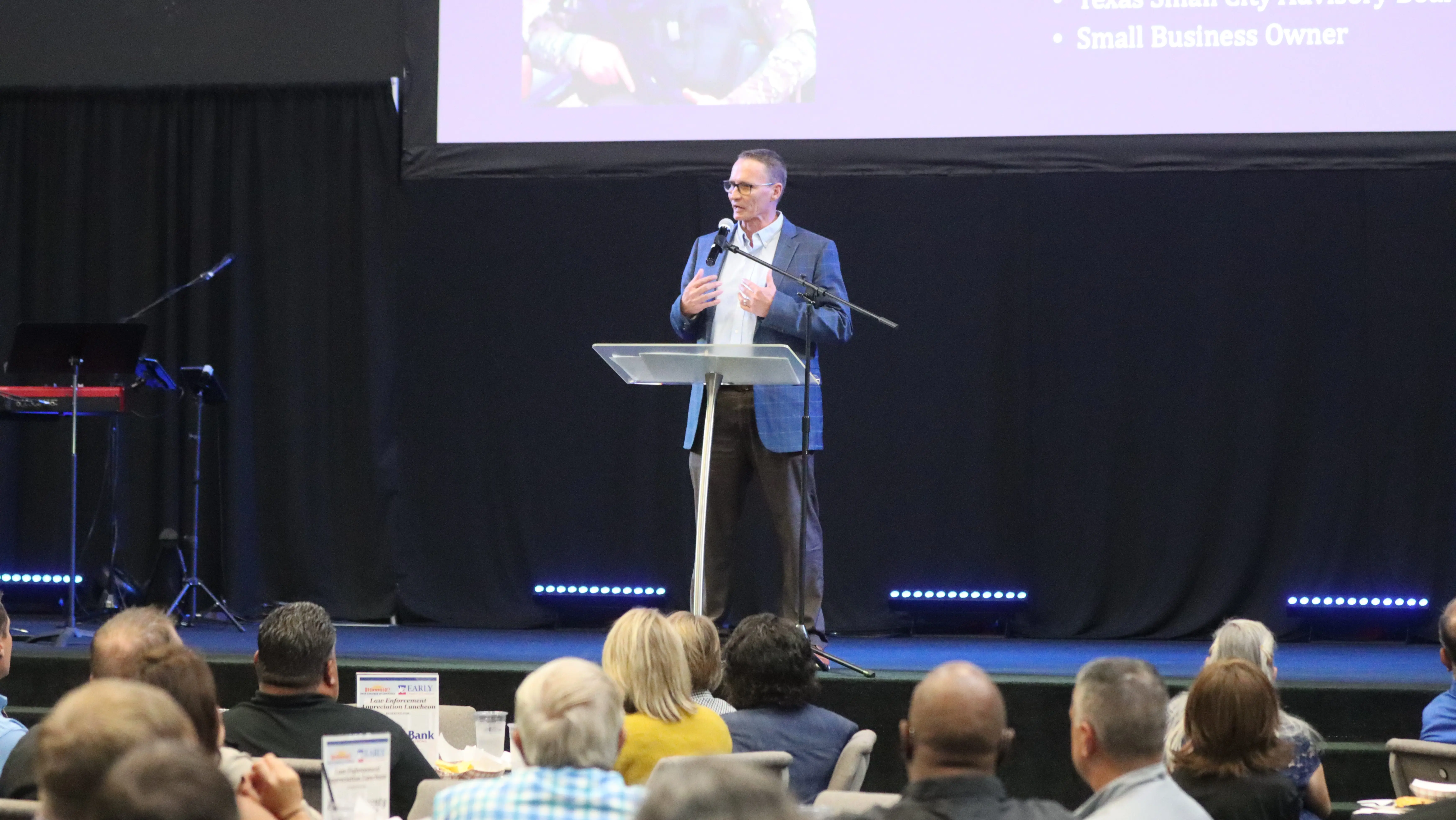
Three hundred people including scores of law enforcement officers and their families attended the annual Law Enforcement Appreciation Luncheon Thursday, hosted by the Brownwood and Early chambers of commerce at Victory Life Church.
Tony Aaron, who has been the Early city administrator for 11 years — preceded by a 17-year career in law enforcement — was the keynote speaker. Aaron spoke on a number of topics including the ways law and enforcement and businesses interact and what the two professions have in common, changes in law enforcement and the need for an officer to be both a warrior and a guardian.
“I think I’m in a unique position,” Aaron said. “I’ve been to these luncheons for a very long time, and I’ve seen different speakers talk. When I was thinking about talking today, I thought about my career path and how I spent so much time in law enforcement, still carry that commission, and now I’m involved in something that’s a little more business-oriented.”
Aaron noted that business owners take financial risks and law enforcement takes personal risks. “Both navigate human relationships, and both deal with the public sometimes when it’s not their best day,” Aaron said.
Aaron noted that law enforcement has been in Texas for 203 years.
As Aaron spoke, side-by-side photos were projected onto a monitor that depicted the different eras of law enforcement. “Look at the difference in how they appear,” Aaron said. “Their equipment, their uniforms, and you can see a progression and a change that has happened over our law enforcement for many, many years.”
Aaron noted a photo of himself as a young law enforcement officer in 1998. “I don’t have a bulletproof vest on, I’m not wearing pepper spray, I’m not wearing a taser. I don’t have a body camera,” Aaron said of the photo.
Aaron continued, “the police technical revolution — that’s when we started getting fingerprinting analysis done better. We have DNA. Big incidents like the Waco Branch Davidian happening, the Oklahoma City bombing, school shootings.
Aaron further noted “the rise of ambushing on law enforcement, Ferguson, Black Lives Matter. That was a big, big thing that went on with law enforcement that we required a shift in mindset in law enforcement. That’s when our society really started trying to decide, are we warriors? Are we guardians? How do we decide who’s going to be what at what time? Body cams are required, great things.
“We’re going into the defunded police, mandating de-escalation training — hey bounce between two different thought processes that we expect an officer to be. And that’s a warrior and a guardian. The struggle to manage both of those roles in my career, and I’m sure there’s officers here that can tell you, it sometimes takes a bit before you shift from that warrior to that guardian mindset and back and forth.”
When an officer goes on a call, Aaron said, “this may just be another call for you, but this is probably the worst day of (a citizen’s) life. If you’ve ever been victimized by burglary, theft, somebody’s been in your house, that’s some of the worst feelings that you can have.
“I think it’s a good idea for law enforcement to be mindful of that. And I used to remind my officers that all the time — take the time to recognize that this could be the worst day in somebody else’s life.”
Contrasting the warrior-vs.-guardian mindset, Aaron said an officer needs to be capable of both.
“Our society expects them to step in and be warriors when we need them to be warriors,” Aaron said. “We also, as a society, expect them to be guardians. We expect them to protect, to serve.
“We expect them to be in schools and talk to kids. We expect them to be empathetic.”
Aaron described a scenario where an officer goes to a crime scene that started with violence. The officer may need to “flip the switch” and end up becoming a counselor, he said.
An officer in a warrior mindset is “very tactical, they’re very command-present, they’re on top of things, they’re really just trying to get down to business, and they’re looking at everything that’s going on,” Aaron said.
“Your guardians, I like to talk about those as our school resource officers, because although they are geared to become warriors when they need to, they have to have that softer approach, they’re around children, they’re around teachers, they have a different demeanor and mindset. Both of these are absolutely necessary, and neither one of them is wrong. But an officer needs to know how to use both of those.
Aaron continued, “so here’s some hypersensitivity about being in that (warrior) mindset. They’re constantly scanning for threats, they have authoritative tone, active threats, domestic violence, pursuit, any of those scenarios that could cost somebody a life, that’s what they’re really focused in on.
“And then that guardian sees the public as a partner. They prioritize listening, rapport, they’re looking to reduce tension, they’re very community-approach mindset, and they take a conscious effort to try to please that individual. I want to promote the fact that as law enforcement officers we have to have the guardian mindset. And be prepared to flip it to a warrior mindset.”
Noting that law enforcement officers don’t see themselves as heroes, Aaron said, “you have people that believe that about you.”
Aaron concluded by saying, “hopefully everybody that showed up here realized that the community was here to bless them and thank them. It’s a commonality that gets us together as people.”
To non-law-enforcement citizens, Aaron said, “introduce yourself to police officers. Talk to them when you don’t need something to them. It’s so much more inviting and comfort when a police officer and the public know each other.”